
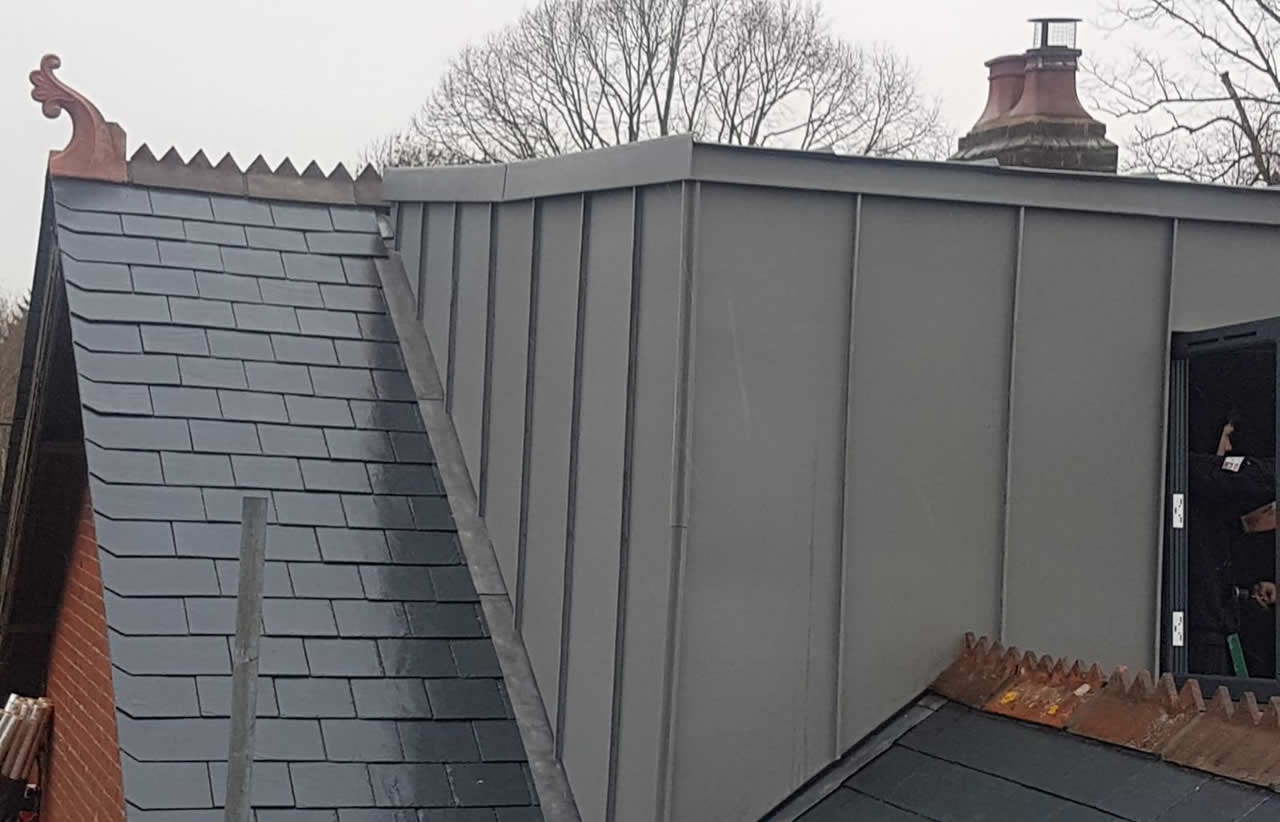
Leadwork is one of the most critical — and most frequently misunderstood — components of a roof. It is rarely discussed in the same breath as slates or tiles, yet in many cases it is the leadwork that determines whether a roof is truly weathertight. When it fails, the consequences can be serious: persistent water ingress, damaged roof timbers, saturated insulation, and costly interior damage that is both disruptive and difficult to remedy.
Understanding what leadwork is, where it is used, and how to recognise when it needs attention is valuable knowledge for any property owner.
What Is Leadwork?
Lead is a soft, malleable metal with outstanding natural weather resistance and, when correctly installed, an exceptional lifespan. In roofing, it is used to create watertight seals wherever two different surfaces meet — junctions that would be impossible to waterproof with tiles or slates alone. Its malleability means it can be formed, folded, and dressed to fit complex shapes with precision; its durability means correctly installed leadwork can last 50 to 100 years or more.
Where Is Leadwork Used on a Roof?
Flashings
Flashings are strips of lead used to seal the junction between a roof covering and a vertical surface — the most common example being where a roof meets a chimney stack or a parapet wall. They prevent water from running down the vertical surface and penetrating behind the roof covering. Step flashings, soakers, aprons, and cover flashings all serve specific functions within this category.
Valleys
Where two roof slopes meet — forming a valley — the junction must be sealed to prevent water pooling and penetrating the roof structure. Lead valleys are formed by dressing sheet lead into the valley angle, providing a durable, weather-resistant channel that directs rainwater efficiently down to the guttering. Valleys are among the most demanding areas for roofing materials, and lead performs better here than almost any alternative.
Box Gutters and Parapet Gutters
Flat or near-flat gutters built into the roof structure — commonly found in older and period buildings — are typically lined with lead. These are demanding environments: the lead must accommodate significant thermal movement across its length while remaining continuously watertight. Correct sizing, appropriate lead code selection, and properly designed expansion joints are critical to long-term performance.
Soakers
Soakers are small interlocking pieces of lead used beneath roof tiles or slates at abutments — typically where a pitched roof meets a wall. Each soaker slot under an individual tile or slate and folds up against the adjacent wall, preventing water penetration at a junction that would otherwise be highly vulnerable to ingress.
How Long Should Leadwork Last?
Well-executed leadwork, using the correct lead code for the application and allowing appropriate tolerances for thermal movement, should last 50 to 100 years. Lead is one of the most durable roofing materials in existence — it is not uncommon to encounter Victorian leadwork that remains fully serviceable today, well over a century after installation.
However, leadwork can fail prematurely if installed incorrectly. Common causes of early failure include using a lead code that is too thin for the application, insufficient allowance for thermal expansion and contraction, poor fixing methods, or simply inadequate craftsmanship. In these cases, replacement may be necessary far sooner than it should be.
Lead expands and contracts with changes in temperature. Correctly designed leadwork allows for this movement through properly sized bays and appropriate joints. Leadwork fixed too rigidly, or installed without adequate expansion allowances, will eventually crack — regardless of the quality of the lead itself.
Signs That Leadwork May Need Attention
Because leadwork is hidden beneath or behind roof coverings, it is not always easy to inspect from ground level. There are, however, indicators that warrant closer investigation.
- Water stains or damp patches on internal ceilings or walls — particularly near chimney stacks, dormer windows, or roof edges
- Visible cracking, splitting, or lifting of lead flashing when viewed from a safe vantage point or during a professional inspection
- Lead that has visibly crept downward from its original position — a sign of incorrect installation without adequate fixing
- Efflorescence (white mineral deposits) on brickwork adjacent to flashings — often indicates water is tracking behind the lead
- Failed mortar pointing around step flashings or where lead meets masonry
If any of these signs are present, a professional inspection is strongly recommended. Attempting to seal failing leadwork with mastic or sealant products is a temporary measure at best — it does not address the underlying cause and can, in some cases, accelerate deterioration.
Repair or Replace?
Not all leadwork problems require full replacement. If the lead itself is in sound condition but the fixing, pointing, or detailing has failed, repair is often straightforward and cost-effective. If the lead has cracked, crept significantly from its position, or was originally installed using an insufficient code for the application, replacement is usually the correct course of action.
Our advice is always based on the genuine long-term interest of the property. Where repair is appropriate, we carry it out correctly and durably. Where replacement is needed, we specify the correct lead code and expansion allowances, and ensure the work is executed to a standard that should last another 50 to 100 years.
Heritage Properties and Traditional Leadwork
On listed buildings and period properties, leadwork is often both functional and historically significant. Decorative lead details, ornamental gutters, and traditional lead-lined box gutters should be repaired and preserved wherever possible, using traditional craft techniques and appropriate lead codes.
We specialise in heritage leadwork and have extensive experience working on protected buildings, always with a repair-led philosophy that preserves original materials for as long as they remain viable.


